The Saona Island Day Trip: What the Brochure Leaves Out
Updated September 24, 2026 · 7 min read
Saona is the picture everyone has seen before they arrive: palms leaning over white sand, water in three shades of blue, a starfish on a sandbank. It is also the single most-booked excursion sold on this coast — of the 118 island trips currently on offer, the big catamaran crossing alone carries 4,703 reviews.
What almost nobody tells you in advance is that the day does not start at sea. It starts on a coach.
Saona is not in Punta Cana
The island lies inside Cotubanamá National Park, the protected area at the south-eastern corner of the country that was declared a national park in 1975 and used to be called Parque Nacional del Este. Boats to Saona leave from one place: the small port of Bayahibe, roughly 90 minutes down the coast by road from the Punta Cana hotel zone.
That means the shape of the day is fixed, whichever trip you book:
- hotel pickup, usually between 6:30 am and 8:00 am
- around 90 minutes on the road to Bayahibe
- the crossing, 30 to 60 minutes depending on the boat
- the natural pool, a beach, lunch
- the same journey in reverse
Most trips run 8 to 10 hours door to door. The cheapest ones on the list run longer, not shorter, because they collect more hotels on the way.
In Bayahibe there is a park office beside the coach park where the national park fee is paid and everyone is given a wristband. On a packaged trip this is normally already included and handled by the guide — but the wristband is not optional, and it is the reason for the queue.
The natural pool and the one rule that matters
Somewhere between the mainland and the island the boat stops over a sandbank that sits waist-deep in open sea — the piscina natural. You get out and stand in the Caribbean with no land in sight. It is the part of the day people remember.
Starfish live on that sandbank, and there is one rule about them:
Do not lift a starfish out of the water.
They take in oxygen through the underside of their bodies. Held up for a photograph, a starfish suffocates — not in an hour, in a matter of seconds to minutes. Park regulations prohibit it and rangers do come past in small boats, but the honest reason to leave them alone is not the regulation.
Good guides say this before anyone gets in. If yours does not, you now know anyway.
Mano Juan, and what “the beach lunch” means
Most trips land at or near Mano Juan, the only village on Saona — a few hundred people in a row of painted wooden houses, with a small sea-turtle hatchery at one end. It is the only part of the day where the island is a place rather than a backdrop.
Lunch is a buffet on the sand: rice, chicken or fish, salad, fruit. Drinks are usually included and usually open bar. This is worth knowing in advance because it sets the tone of the return crossing, which on the larger party boats is loud, with music and a lot of rum. On the small-group trips it is not. Neither is wrong; they are different days out, sold with almost the same photographs.
Which boat, and what the ratings actually say
Three formats dominate the island tours:
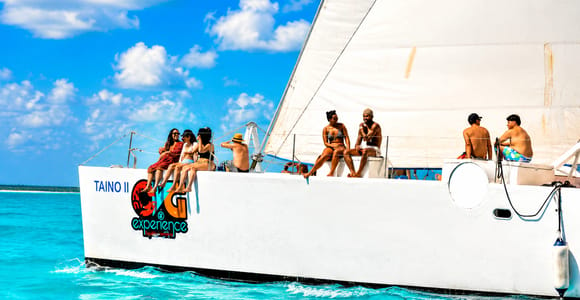
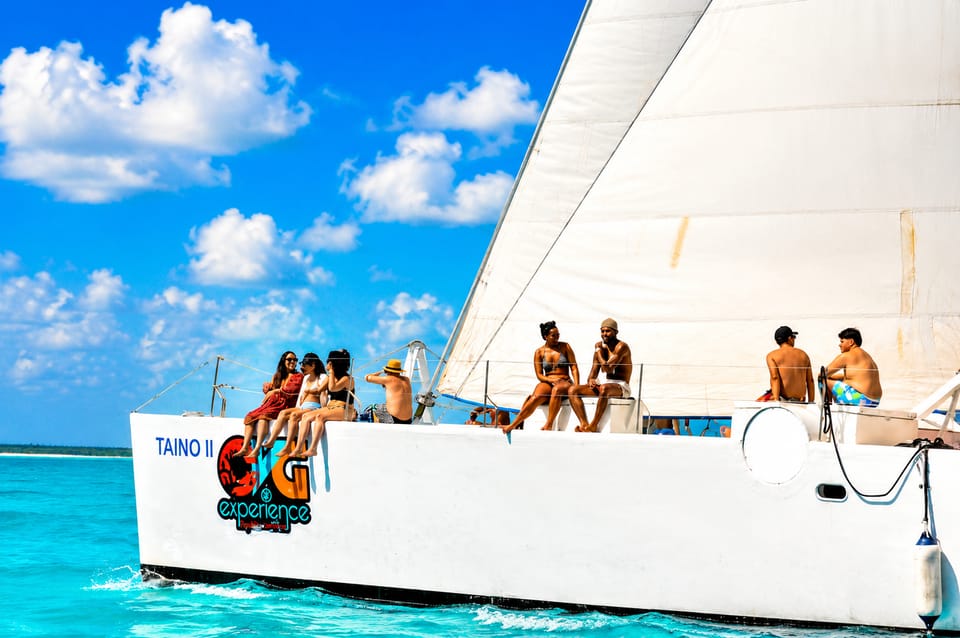
The large catamaran. The classic: sail out slowly with a drink, come back faster by motorboat, or the other way round. This is the most-booked format by a wide margin. On our list it sits at 4.4 stars across those 4,703 reviews.
The speedboat. Less time on the water, more time on the island, no sail. Worth it if the boat is a means and not the point.
The small-group trip. Fewer people, later start, a quieter beach. It also carries the highest rating of any Saona trip among the twenty most-booked — 4.7 stars from 745 reviews, at €94 against €72.03 for the big catamaran.
That gap is the useful signal in the numbers. The most-reviewed trip is not the best-rated one; the cheapest, biggest-bus versions sit around 4.0. You are choosing, roughly, between crowd and cost. The island list starts at €5.27, but at that end you are looking at short whale-watching runs out of Samaná and Miches, not a Saona day.
If sailing is more interesting to you than the island itself, the catamaran trips along the local coast are a shorter day for a similar feeling, and several of them include snorkelling over the reef.
Who should not book this
This is the part the brochures never carry.
- Anyone travelling with a toddler. Three hours in a coach plus an hour on a boat, either side of a long hot middle, is a lot to ask. Punta Cana with kids suggests what works better at that age.
- Anyone prone to seasickness. The open crossing can be choppy when it is windy, and the return is usually the rougher leg. Sitting mid-boat and keeping your eyes on the horizon helps; anything beyond that is a question for a pharmacy before you travel, not for us.
- Anyone with three days here. Saona will eat one of them whole. A shorter boat trip or a morning in the cenotes leaves the rest of the day intact.
- Anyone chasing an empty beach. In high season, dozens of boats converge on the same stretch of sand between roughly 11:00 am and 2:00 pm. The later small-group departures exist precisely because of this.
Practical, in one block
Take reef-safe sunscreen, a hat and a dry bag; there is very little shade at the natural pool and none at all in the water. Cash in small notes is useful at Mano Juan, where the vendors are local and card machines are not a given. Bring your own water even where drinks are included — the open bar is not the same as drinking water.
And take the crossing time seriously when you pick a departure. The difference between an 8-hour trip and an 11-hour one is not the island. It is how many hotels the bus visits before yours.
If you would rather stay closer to base for a day, the day trips list has the shorter options, and what to see in Punta Cana sets out how the rest of the coast fits together.