La Altagracia: The Province Your Hotel Is In, and Why It Explains the Water
Updated September 24, 2026 · 9 min read
Nobody books a holiday to La Altagracia. People book Punta Cana, or Bávaro, or a hotel name, and they fly home without ever learning that all of it sits inside one province with a name of its own.
It is worth ten minutes, because the province explains things the hotel brochure does not: why one beach half an hour from another behaves completely differently, why every boat to the famous island leaves from the opposite coast, and why two of the excursions sold to you are twice as long as the rest.
The one fact that organises everything
La Altagracia covers 3,010 square kilometres at the eastern end of the Dominican Republic and had 446,060 inhabitants at the 2022 census. It has existed as a province in its present form since 1961. Its capital is not Punta Cana — it is Higüey, inland.
And it is the only province in the country that touches both the Atlantic Ocean and the Caribbean Sea.
That is not a piece of trivia. It is the reason for almost everything a visitor notices:
- The coast you are staying on — Punta Cana, Bávaro, Arena Gorda, Macao, Uvero Alto — faces east and north, into the Atlantic. It gets swell and wind off open ocean.
- The coast on the other side of the province — Boca de Yuma, Bayahibe, and the water around Saona — faces south, into the Caribbean. It is a calmer sea with a different character.
Two beaches in the same province, an hour and a half apart by road, are not variations on a theme. They are different oceans. That is why Macao has surf schools and Bávaro does not, why the boats to Saona sail from the southern side rather than from your hotel beach, and why the sea conditions you get depend on which way your particular stretch of sand is pointing.
The other thing softening the water on the central stretch is the offshore reef, which is a local feature rather than a provincial one — what to see in Punta Cana goes into how that works along the hotel strip.
How the province is actually divided
There are only two municipalities: Salvaleón de Higüey and San Rafael del Yuma. Underneath them sit five municipal districts — Verón-Punta Cana, Bayahibe, Boca de Yuma, La Otra Banda and Lagunas de Nisibón.
Read that list again and something stands out. “Punta Cana” is not a town in its own right; it is half the name of a district it shares with Verón, the working settlement on the main road that most visitors pass through in the dark on the way from the airport. The hotel strip is an administrative appendix to somewhere most guests never see.
Higüey: the capital, and the reason for the province’s name
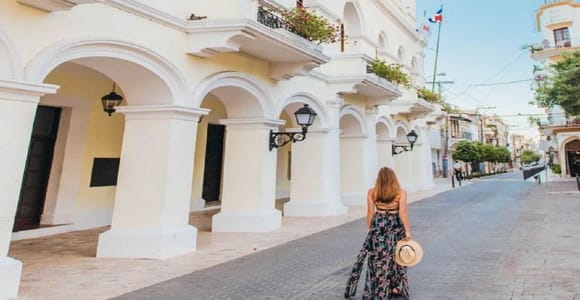
Higüey is 45 minutes inland and holds the country’s principal pilgrimage church, dedicated to Our Lady of Altagracia — the patroness the province is named after. It is a vast concrete building from 1971 by a French architectural team, and twenty minutes’ walk away stands the sanctuary it replaced, built in the years around 1569.
It is also where most of the people who work in your hotel live. The full picture, including what the half-day tours do and what to expect from the town itself, is in our guide to Higüey. Trips there sit on the culture tours page — 117 offers, the cheapest starting at €3.51, which is the lowest entry price of anything sold on this coast.
The national park, and the island everyone photographs
Cotubanamá National Park — for decades called Parque Nacional del Este — covers 791.9 square kilometres of land and sea across the southern corner of this province and neighbouring La Romana, and takes in Saona itself.
This matters more than it sounds. The most-booked excursion sold anywhere on this coast is a boat day to Saona, and it never leaves La Altagracia. The coach ride at the start is not a journey to another region; it is a crossing of your own province from the Atlantic side to the Caribbean side, to Bayahibe, the small port that every Saona boat departs from.
The trip and its honest timings are covered in the Saona day trip guide, and the island offers — 118 of them from €5.27 — sit together on one page. Bayahibe is worth knowing about for another reason: it is the base for park walks and cenote snorkelling that do not involve the big catamarans at all.
The limestone underneath
The whole province is built on porous limestone, and rainwater has been dissolving it for a very long time. What is left is a landscape full of holes: caves, underground rivers and the flooded sinkholes sold here under the Mexican word cenote.
There are 174 of them on the cenote list starting at €7.91, and they are not one product — a guided visit to a protected lagoon and a ten-minute swim stop on a buggy tour are both advertised with the same word. Swimming in the cenotes of Punta Cana separates them out.
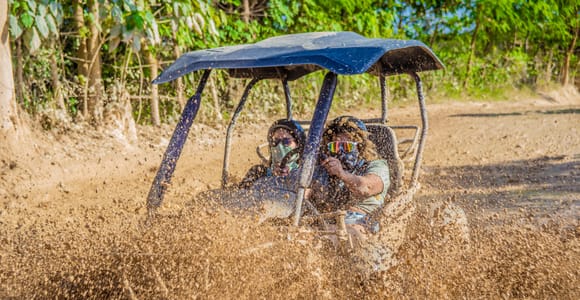
The same limestone is why the buggy and ATV tours — 99 of them, also from €7.91 — all end up at a cave, and why the interior tracks are red dust in the dry months and red mud after rain. What those four hours contain is set out in our buggy guide.
What is not in this province — and why those days are long
This is the most useful thing on the page for planning a week.
Two of the most heavily marketed day trips leave La Altagracia altogether:
- Santo Domingo is about 200 kilometres west, in a different part of the country entirely. It is a 10- to 12-hour day, and our guide to it explains why its ratings sit lower than everything else that sells in comparable numbers.
- Los Haitises, the mangrove and cave park, is on Samaná Bay in the north-east, reached by boat from a port in another province again. The version sold from here usually adds a waterfall and the swings above Miches — which is also outside La Altagracia, in El Seibo. The full day is described here.
Everything else — Saona, the cenotes, Higüey, the monkey reserve in the Anamuya hills, the buggy tracks, the reef — is inside your own province. If a trip is being sold to you as an all-day expedition and it stays in La Altagracia, ask what is taking so long.
Getting around it
Almost nothing here requires you to drive. Excursions come with hotel pickup and the airport comes with a transfer, which is why do you need a car in Punta Cana answers its own question with “mostly no”.
The province is the exception to that. Seeing more than one corner of it — the Atlantic beaches in the morning, the Caribbean side in the afternoon, a town in between — is the one itinerary no operator sells, because it is nobody’s product. If that is the holiday you want, it is worth comparing rental cars for Punta Cana before you fly, and reading the questions to ask before signing anything.
A three-day version
If you want to see the province rather than a resort inside it:
Day one, the Caribbean side. Bayahibe and the water around the national park. Either the full Saona day or one of the smaller park and snorkelling trips out of the same port.
Day two, inland. Higüey — both churches, the market — and the countryside behind it. Half a day, back for the afternoon.
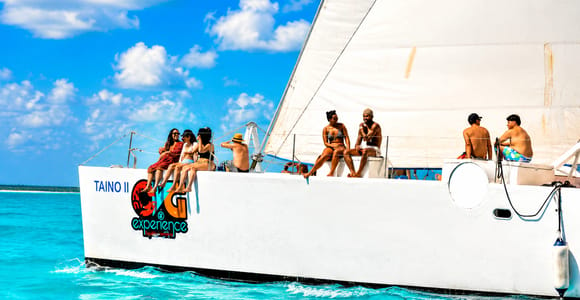
Day three, the Atlantic side. Macao early, before the buggy groups arrive, and the coast north towards Uvero Alto. Then whichever boat you fancy: the catamaran offers run from €5.27, and what they actually are is a question worth settling before you book one.
That is three days that would look identical on a map and feel nothing alike — which is, in the end, the whole argument for knowing which province you are in.